By William Nibbelin, Head of Industry Data and Actuarial Science, Triple-I
The U.S. homeowners insurance industry achieved a net combined ratio of 87.9 in 2025, according to Triple-I’s latest State of the Line: Homeowners Issues Brief. As the second largest line of the property/casualty (P/C) industry by premium volume, homeowners has outperformed the broader industry in only seven of the past 20 years.
Combined ratio is the most common measure of insurer underwriting profitability. It is calculated by dividing the sum of the claim-related losses and expenses by premium. A ratio over 100 indicates the industry is paying out more than it is taking in.
Premium Growth Cools Down
Homeowners net premiums written grew 9.9% in 2025, compared with 4.9% for the P/C industry overall. The pandemic-related surge in homeowners premiums appears to be stabilizing, with growth in 2026 projected to fall lower than 7%. The figure aligns with findings in the latest Insurance Economics and Underwriting Projections: A Forward View report from Triple-I and Milliman.
Even so, recent increases pose an affordability challenge, which Triple-I’s Insurance Affordability Index examines countrywide and by state.
Premiums and Loss Trends
Homeowners insurance trends tack closely with housing-related economic indicators:
- Premium Rates: Housing starts, residential construction employment, and building materials retail sales each maintained a correlation above 0.80 with average effective rate changes from 2016 to 2025, leading them by one to two years.
- Claims Frequency: Weighted together, residential construction employment and building materials retail sales maintained a 0.74 correlation, leading frequency by one year.
- Claims Severity: Over 95% of incurred losses arise from property damage, so replacement costs largely determine severity. Weighted together, construction materials and household furnishings price indexes maintained a 0.70 correlation, leading severity by two years.
Competition and Availability
The homeowners market is considered competitive by Department of Justice standards, with a Herfindahl-Hirschman Index (HHI) below the “moderately concentrated” threshold of 1,000. Competition has improved even further within the excess and surplus share of the homeowners market, with the HHI dropping from 2,056 in 2016 to 1,040 in 2025.
Reliance on non-standard coverage is also growing. Homeowners direct written premium doubled between 2017 to 2025, the residual market share of which rose from 2.4% to 2.9%. California and Florida hold the largest non-standard shares of premium, with California’s share rising from 8.5% to 15.0% from 2023 to 2025. In contrast, conditions in the Sunshine State have improved in recent years since legal system reforms were enacted.
Emerging Risks
Roof repair and replacement is a key cost driver across convective storm and hurricane losses, yet industry data on roof claims remains limited. The Insurance Research Council –an affiliate of The Institutes, like Triple-I – is exploring a homeowners claims analytics database, called HOMECAD, to help fill the knowledge gap.
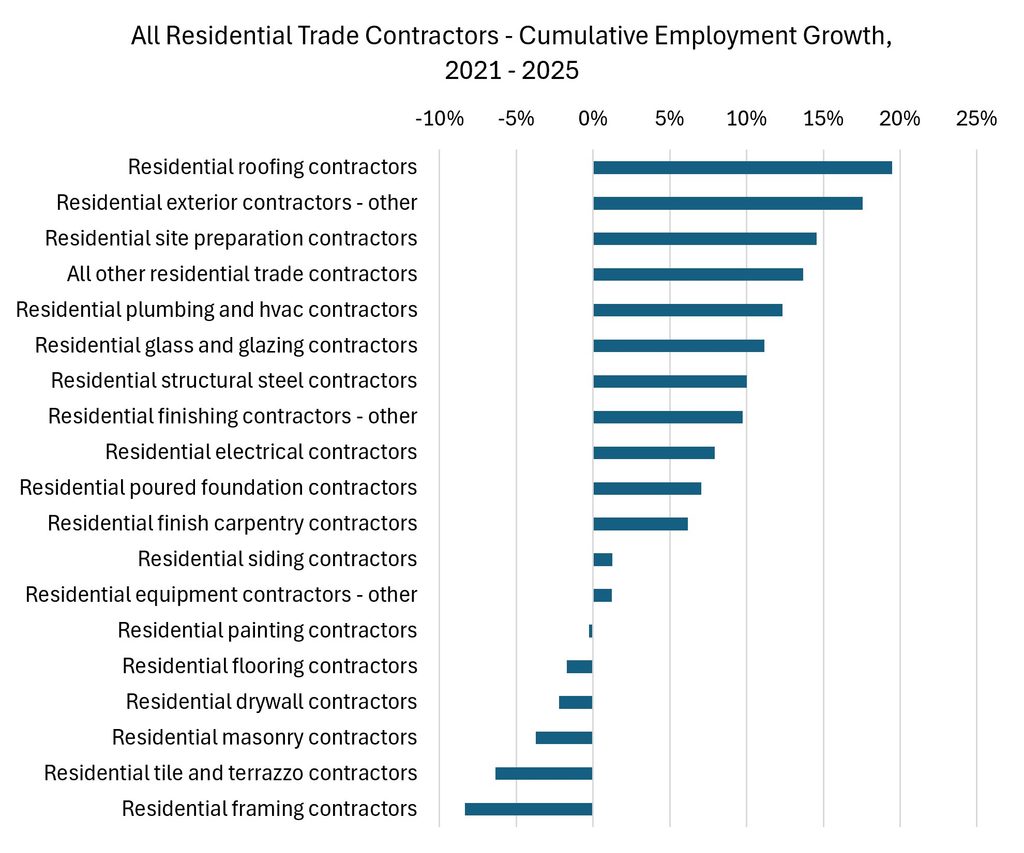
Bureau of Labor Statistics data show employment among residential roof contractors grew 19.5% from 2021 to 2025, outpacing all other residential trade contractors and more than double the growth across all private industries, as shown in the figure below. This disparity may signal mounting contractor fraud after natural disasters. The National Insurance Crime Bureau reports contractor fraud climbed 28% from 2023 to 2025.
Learn More:
State of the Line: Homeowners Issues Brief (members only)
Triple-I Insurance Affordability Index
Convective Storms: State of the Risk Issues Brief (members only)
Hurricanes: State of the Risk Issues Brief (members only)
Excess and Surplus: State of the Risk Issues Brief (members only)
Contractor Fraud Awareness Week | National Insurance Crime Bureau